Visitors from the United States, Canada, the United Kingdom, Ireland, Australia, and most EU countries do not require a visa for tourist visits up to 90 days. You will need a valid passport with at least 6 months of validity from your date of entry. Always check with the Moroccan consulate in your country before traveling.
In terms of the world today, Morocco is considered a safe country. In fact, the crime rate is very low. Morocco stands committed to dedicating significant resources to counter-terrorism intelligence, both on the national and international levels. The Kingdom of Morocco is stable politically and receives more tourists than any other African country. Of course, every potential visitor must use his or her own judgment regarding traveling to anywhere in the world. We at Morocco Travel Boutique consider Morocco a very safe place to be not only for ourselves, but for our families.
Absolutely! We specialize in tailor-made Morocco tours. You can customize every aspect of your trip — destinations, duration, accommodation level, activities, and pace. Contact us through our Tailor Made page and we’ll craft your perfect Moroccan adventure.
Simply browse our tours and click ‘Book Now’ on any tour page. Fill out the booking form with your details. We’ll confirm your booking within 24 hours and send you a detailed itinerary and payment instructions.
All our tours are private, meaning you get a dedicated driver/guide and vehicle just for your group. This gives you maximum flexibility with timing and stops.
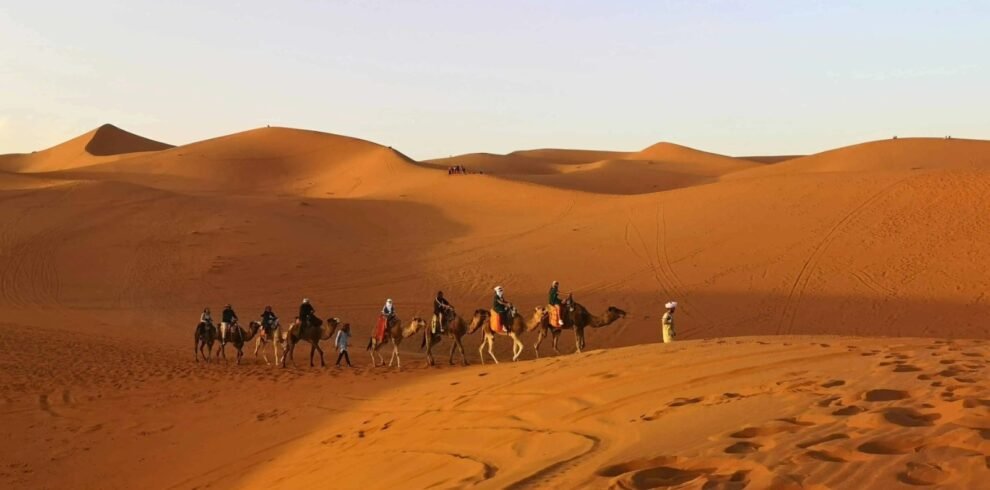
All our tours include private air-conditioned transportation, an expert multilingual driver/guide, handpicked riads and hotels, daily breakfast, airport transfers, and all entrance fees to monuments and attractions. Sahara desert tours include a camel trek and overnight in a traditional Berber camp. Some meals (lunches and dinners) are included depending on the tour.
From the U.S.: Royal Air Maroc has direct flights from New York (JFK) to Casablanca, and Delta has direct flights to Marrakech from different states(Florida, Washington DC, Georgia,and California). Otherwise there are multiple flights with layover in Canada and Europe such as Iberia, Air France, and Air Canada.
From Europe: Many low-cost carriers fly directly to Marrakech, Fes, Casablanca, Agadir, and Ouarzazate. Otherwise a ferry from Tarifa Spain to Tangier is a great option for travelers who prefer ferries and start their tour from Tangier.
Within Morocco: Domestic flights are available and reasonably priced via Royal Air Maroc.
The official currency is the Moroccan Dirham (MAD or DH). You can exchange money at airports, banks, and official exchange offices. Major currencies like USD and EUR are widely accepted for exchange.
Upon arrival, your Morocco Travel Boutique driver will take you to a trusted exchange office where you can conveniently convert your money at competitive rates. ATMs are also available in cities and tourist areas, but it’s a good idea to carry some cash for rural areas and small purchases. Credit cards are accepted in most hotels, restaurants, and larger shops, but cash is preferred in souks and smaller establishments.
Morocco is moderately conservative. To respect local customs, women should avoid revealing clothing and carry a scarf for religious sites. Men should avoid tank tops and very short shorts. While cities like Marrakech and Casablanca are more relaxed, rural areas are more traditional. Dressing modestly shows cultural sensitivity.
Morocco uses the European-style plug types C and E, with a standard voltage of 220V, 50Hz. If your home country uses 110V (like the US or Canada), check if your device is dual voltage (e.g., ‘Input: 100-240V’). If not, bring a voltage converter.
Comfortable walking shoes, modest clothing (covering shoulders and knees), a light jacket for evenings, sunscreen, a hat, sunglasses, a reusable water bottle, a universal adapter (Morocco uses European-style C and E plugs, 220V), and a small backpack for day trips. For desert tours, bring a scarf to protect from sand and warm layers for cold nights. Depending on the season, we provide a packing list for our guests once they confirm with us.
Drinking tap water is not recommended. Most travelers prefer bottled or filtered water. Some hotels offer purified water and your guide can advise you where to find it. To minimize plastic waste, we suggest bringing a reusable water bottle. And it’s worldwide available.
Yes! Morocco offers a variety of delicious vegetarian and vegan dishes. You’ll find vegetable tajines, couscous with vegetables, harira (without meat), lentil and bean stews, fresh salads and fruit, and vegetarian briouats (pastry parcels). In larger cities and during our standard tours, vegetarian options are easily accessible. Just inform us during the booking process or your guide or host of your dietary preferences, especially if traveling to rural areas.
There are multiple reasons to select Morocco Travel Boutique for your Morocco vacation. First, our primary goals are to create amazing experiences for our guests, while relating ethically with the Moroccan nationals. Those who choose to travel independently in Morocco, miss out on so many things that can only be experienced with a local guide. Your MTB guide is the touchstone between you and Moroccan culture. They love introducing guests to their country and being involved in cross-cultural experiences. You will have the opportunity to meet some very special Moroccan people as you travel throughout the country simply because you are with a Moroccan.
Depending on where you are in the country, we may hire an additional guide. For instance, we always hire a guide in Fes and Marrakech.
Secondly, traveling with us enables you to forget about the details. We will handle everything from touchdown to departure.
Finally, at Morocco Travel Boutique we believe in paying our guides a thriving wage. We don’t pay them peanuts for their knowledge and expertise. They are passionate about their work and sharing their country with others. They work hard and should be adequately compensated for their work. This is unusual in the tourism industry and it’s something we don’t compromise on.
For the full list of how we plan, guide, and care for you see our top 10 reasons to choose Morocco Travel Boutique
The majority of the time we use Toyota Land Prados. These are the same as Toyota Land Cruisers in the United States. Although the legal limit is six guests in these vehicles, we have found that four guests is the limit in terms of comfort.
In much of Morocco, 4x4s are the best means for transportation. However, there are exceptions depending on the make up of the group. For families, we often use Mercedes minivans and Ford Tourneo. If the desert is included in a trip where a van is utilized, it will be necessary to switch out to 4x4s in the desert. A mini bus is often utilized for a larger group tour. If a group is traveling to the desert, it is necessary to switch out to 4x4s at that time. Some small groups travel in a caravan of 4x4s.
Tipping has become very common in Morocco because tourism is such a large part of Morocco’s economy, tipping is regular practice in the country.
To alleviate searches for small change, sometimes we offer a tipping caddy. You can pay into the caddy and your local guide will use those funds to pay the hotel staff, city guides, camel guide, and luggage porters for you. The tipping caddy doesn’t include the tip for your local guide. We leave that up to you at the close of the tour. If interested in this service, just ask at the time of booking.
Upon booking, we will provide you with some good rules of thumb for tipping in Morocco.
As a note, you are expected to tip the “keeper of the bathroom” 2-3 dirhams when using the facilities. However, if the bathroom is not clean or stocked with toilet paper, do not feel you need to pay a tip.